
Key Takeaways:
- Your investment timeline should determine whether short-term investments or mutual funds fit best.
- Short-term investments prioritise liquidity and capital preservation for money needed soon.
- Mutual funds offer diversification and are generally better suited to longer-term financial goals.
- Balanced mutual funds can provide growth potential with less volatility than pure equity funds.
- Matching the investment to the goal helps avoid sacrificing either liquidity or long-term growth.
- Holding both short-term investments and mutual funds can support different financial goals
Mutual Funds vs Short Term Investments: Which Fits Your Financial Goals?
If you are trying to decide between mutual funds in Jamaica and short term investments, the real question is not which one sounds better. It is which one fits the money you actually have, when you need it, and how much volatility you can stomach.
That is where a lot of investors get tripped up. They chase the phrase “higher return” without asking a more important question: how long can I leave this money alone? In Jamaica, that answer usually matters more than the product name.
| What to Remember: Short term investments protect near-term money. Mutual funds help longer-term money work harder. The best choice depends on your timeline, not on which option sounds more attractive. |
What a Mutual Fund in Jamaica Really Gives You
A mutual fund pools money from many investors and puts it into a mix of assets. That can include money market instruments, bonds, equities, or a blend of all three. The point is simple: you are not betting on one security. You are buying diversification in a single transaction.
That matters because a well-managed fund can soften the blow when one part of the market is struggling. It also makes investing more accessible for people who do not want to pick individual securities or monitor markets every week.
The diversification advantage
There are several types of mutual funds available to Jamaican investors, from conservative money market funds to equity funds with higher growth potential. Each carries a different risk-return profile, so you can choose based on your goal and your time horizon.
The big advantage is flexibility. If you are investing for education, retirement, or long-term wealth building, that structure usually makes more sense than leaving money idle. The trade-off is that mutual funds are designed to be held. Redeeming early, especially during a dip, can work against you.
For readers who want to understand how mutual funds fit into a broader portfolio, building wealth with mutual funds covers the portfolio construction side in more detail.
Explore Mutual Funds by Sterling
What Short-Term Investments Are Really For
That is why many people searching for the best short term investments are not actually looking for the highest return. They are looking for a place to park cash without taking on too much risk. That is a very different job from what a mutual fund is designed to do.
Common short-term instruments in Jamaica
In Jamaica, typical short-term options include:
- Repurchase agreements (repos): Flexible tenors, generally 30 to 365 days, with returns above a standard savings account. Useful when you need liquidity but want to earn while you wait.
- Treasury bills (T-bills): Available in JMD and USD. US T-bills are considered among the lowest-risk instruments globally, though yields reflect that safety.
- Certificates of deposit (CDs): Fixed rate, fixed tenor. The longer you commit, generally the higher the return.
For a deeper look at how these instruments work and when to use them, this guide on savvy short-term moves walks through each option with practical context.
Explore the Savvy In The Short Term guide for a deeper look at how these instruments work and when to use them.
Explore Short Term Investments by Sterling.
Where Balanced Mutual Funds Fit
Balanced mutual funds are often the most practical middle ground. They typically combine growth assets (equities) with income-oriented assets (bonds or money market instruments), so you get more upside than a very conservative product but with less pressure than a pure equity strategy.
They suit investors who say, “I do not want to take big risks, but I also do not want my money sitting still.” That is a common stance, especially for people building wealth steadily rather than trying to hit a home run.
What makes balanced funds different from pure equity or pure bond funds:
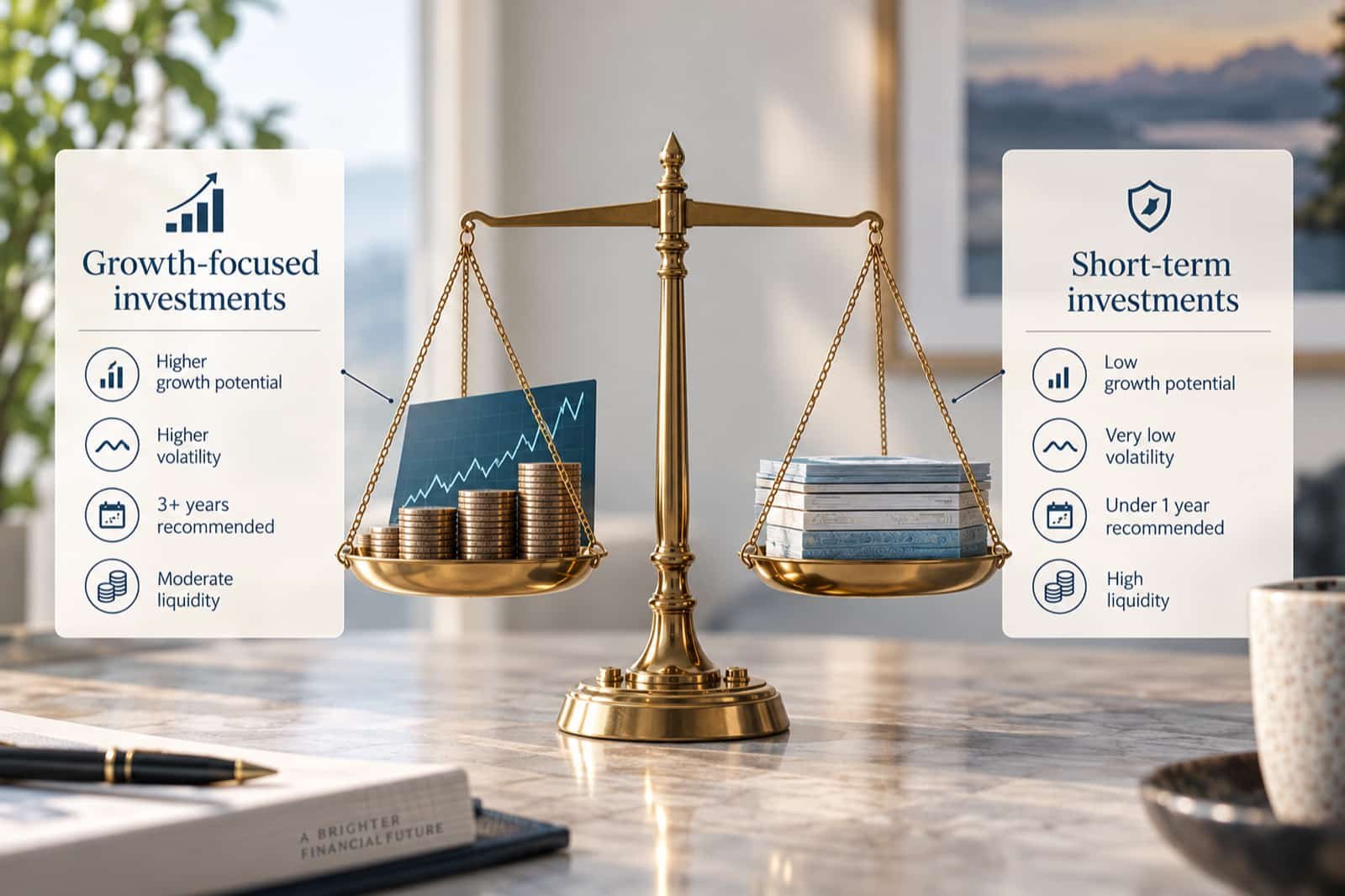
| Feature | Balanced Fund | Equity Fund | Short-Term Investment |
| Growth potential | Moderate | Higher | Low |
| Volatility | Moderate | Higher | Very Low |
| Recommended horizon | 1-3+ years | 3+ years | Under 1 year |
| Liquidity | Moderate | Moderate | High |
The Risk Of Getting It Wrong
There is a mistake I see often: people mix up the purpose of the money with the product. They put emergency funds into something that should have been reserved for longer-term goals. Or they keep long-term money too conservative for too long and miss out on compounding.
Both errors cost money. One costs you access when you need it. The other costs you growth over years.
A practical way to think about it:
- Money you need in under 12 months: keep it in short-term instruments. Prioritize liquidity and capital preservation.
- Money you will not need for 1 to 3 years: a balanced mutual fund starts to make sense.
- Money you are setting aside for 3+ years: a growth-orientated mutual fund or a diversified portfolio is worth considering.
The Bank of Jamaica publishes regular data on local interest rates and monetary policy that can help frame what short-term yields are actually offering at any given time, which is useful context when deciding whether a short-term instrument is genuinely competitive right now.
At a Glance: Choosing the Right Investment Option
| Mutual funds are better when you want to invest for longer than a few months and you want built-in diversification without picking individual securities. |
| Short Term investments are better when you need predictable access to your cash or you are parking funds while you decide on a longer-term move. |
| Balanced mutual funds sit in the middle and can work if you want growth with less volatility than a more aggressive equity fund. |
How to Choose: A Simple Decision Filter
You do not have to choose only one. A lot of investors should hold both, just in separate buckets: cash for short-term needs, funds for medium- and long-term goals.
But if you need a starting point, use this filter:
- Define the goal first. Is this money for an emergency fund, a planned expense, education, or retirement? The goal determines the timeline.
- Set the timeline. Under 12 months: short-term. Over 12 months: mutual fund territory.
- Check your risk tolerance. If market movement would cause you to panic-sell, a more conservative option (or a balanced fund) is better than a pure equity fund you abandon at the wrong time.
- Ask about fees and liquidity terms. Some instruments have early redemption penalties. Know the rules before you commit.
Once the goal is clear, the product choice becomes much easier. If you are still working through your goals, setting financial goals is a good place to start.
The Right Investment for the Right Purpose
Use short-term investments for certainty and timing. Use mutual funds for discipline and growth. They are not in competition with each other. They are tools for different jobs, and most investors benefit from having both.
If you are ready to explore your options, take a look at Sterling’s mutual fund offerings or short-term investment solutions.
If you are not sure where to start, speaking with a financial advisor is the fastest way to match the right product to your actual situation.
FAQs
What is the difference between mutual funds and short-term investments?
Mutual funds pool investors’ money across a range of assets and are generally suited to medium- or long-term goals. Short-term investments focus more on capital preservation and liquidity for money needed sooner.
Are mutual funds in Jamaica suitable for short-term investing?
It depends on the type of fund and your goals, but mutual funds are generally better suited to money you can leave invested for longer. Short-term instruments may be more appropriate when you expect to need the funds within 3 to 12 months.
What are common short-term investments in Jamaica?
Common options include repurchase agreements (repos), Treasury bills and certificates of deposit (CDs). They differ in interest rates, maturity periods, liquidity and risk.
Can I invest in both mutual funds and short-term investments?
Yes. Investors can use short-term investments for near-term expenses and liquidity while using mutual funds for medium- and long-term financial goals.
How do I choose between a mutual fund and a short-term investment?
Start with when you will need the money, your financial goal and your tolerance for risk. Also compare fees, liquidity, potential returns and any early redemption restrictions before investing.