
Key Takeaways:
- Mutual funds pool investor money across a range of securities for easier diversification.
- Fund fees and charges can reduce the returns investors ultimately receive.
- Your financial goals should guide which type of mutual fund you consider.
- Time horizon and risk tolerance help determine which investments may suit your needs.
- The right mutual fund should align with your goals, timeframe and appetite for risk.
The Basics of Mutual Funds
Mutual funds have become an increasingly popular investment alternative for today’s investor because they offer a convenient, cost-effective way to invest in the financial markets.
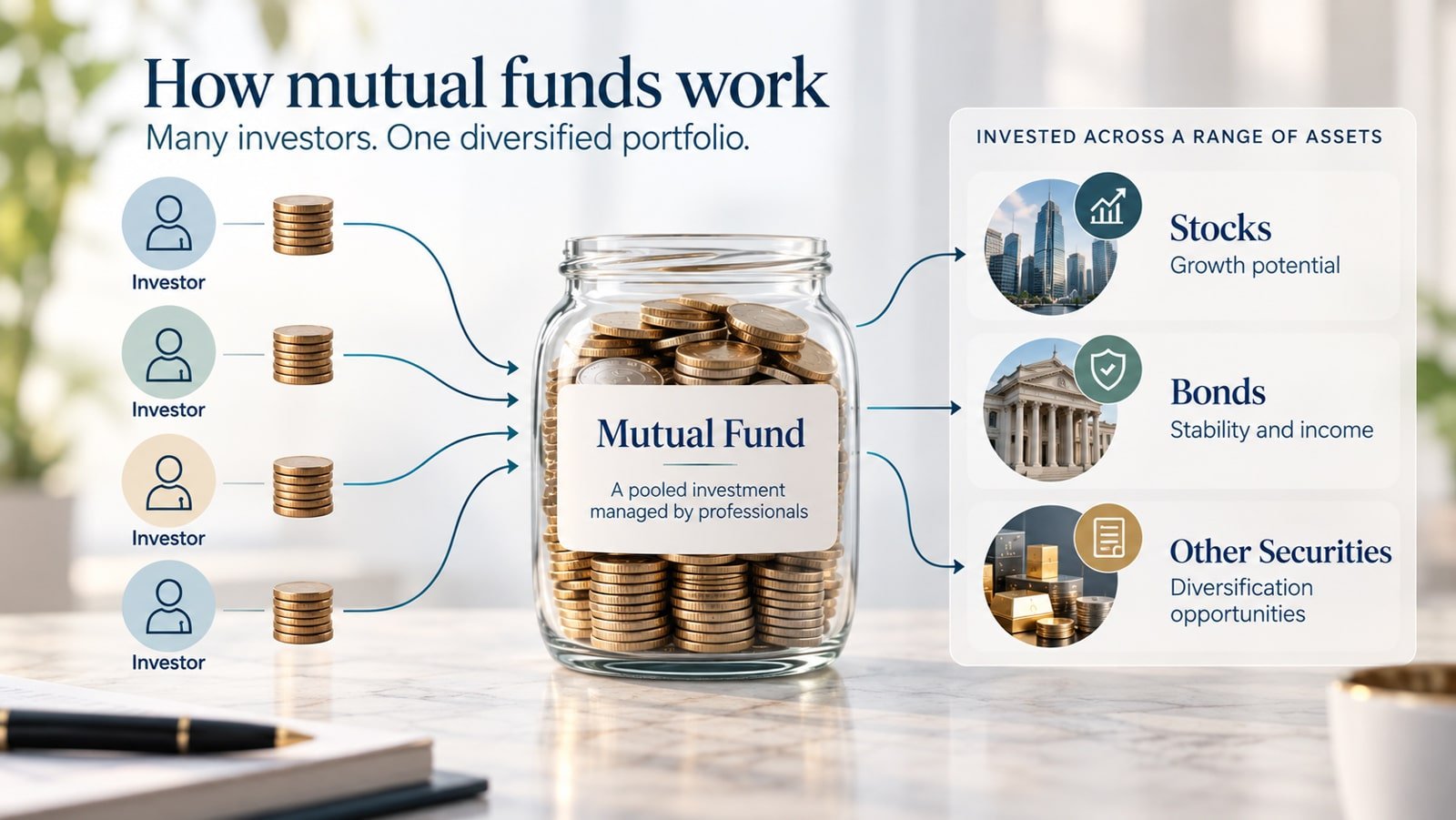
In the simplest of terms a mutual fund is a company that brings together a group of people and invests their money in investment vehicles such as bonds, stocks, money market instruments and other securities. Each investor in the fund owns shares, which represent their portion of the holdings of the fund.
Understanding Common Mutual Fund Investing Terms
Net Asset Value (NAV)Net Asset Value (NAV) – To a mutual fund investor the performance of their investment depends on what happens to the fund’s per-share value or its NAV. This is the current market worth of a mutual fund share calculated daily or weekly by taking the fund’s total assets, deducting any liabilities, and dividing by the number of shares outstanding. |
Ask/Offer PriceAsk/Offer Price – This is the price at which mutual fund shares can be purchased. It is based on the current NAV per share plus any sales charges. |
Bid/Sell PriceBid/Sell Price – The price at which mutual fund shares can be redeemed i.e. bought back by the fund. It is the current NAV less any redemption fees. |
Capital GainCapital Gain – This is any profit that results when the price of a security held in a mutual fund rises above its purchase price. A capital loss on the other hand is the reverse. |
Contingent Deferred Sales Charge (CDSC)Contingent Deferred Sales Charge (CDSC) – This is a fee imposed by certain funds on shares redeemed within a specific time period following purchase. |
Expense RatioExpense Ratio – This is the total expense to net assets of the fund. Expenses include operating costs such as management and administration fees. This ratio is expressed as a percentage of a funds average net assets for a given time period. |
LoadLoad – A sales charge added to the purchase of a mutual fund to cover selling costs. It is usually stated as a percentage or portion of the funds offering price. |
Total ReturnTotal Return – This measures the performance of an investment including yield (interest, dividends and capital gains) as well as any changes in share price, calculated over a designated period of time. Assume for example that your shares are now worth $10,000.00 and the initial investment was $6,000.00 the total return would then be; 10,000 – 6,000/6,000 x 100 = 66.7% |
Beta ValueBeta Value – The beta value is a measure of a fund’s volatility or risk. The lower the beta value, the less risky the fund. |
DistributionsDistributions – This includes any dividends, income or capital gains paid by a mutual fund to its shareholders. |
Choosing the Type of Mutual Fund
Having decided to invest in a fund, the investor faces the task of choosing the fund that is suitable for them. In order to do this, they must ask the following questions.
1) What is my investment objective?
There are several reasons why people invest. Some may be saving to buy their dream house, finance their children’s college education or for retirement. Whatever the answer is to this question, it helps the investor to focus on what it is they are trying to achieve and leads to the next question.
2) What is my investment time horizon?
For example, the investor saving to buy their dream house may want to do so in two years, a relatively short investing time period. On the other hand, the investor saving for retirement in, say, the next 25 years has a longer investment time horizon.
3) How much risk am I willing to take?
In assessing your risk level, you must consider your time horizon as discussed above. The shorter your investment horizon, the less risk you are willing to take but an investor with a longer time horizon may be willing to ride out the periodic ups and downs of the market.
Other factors to consider when assessing how much risk to assume include the age, income level, expenses and liquidity needs of the investor.
For a deeper look at the different options available, read our guide to Types of Mutual Funds and How They Work.

Choosing a Mutual Fund That Matches Your Investment Profile
After answering the questions above, you should have a clearer idea of the type of mutual fund that aligns with your objectives, risk tolerance and investment timeframe. A financial advisor can help you assess the available options and make an informed decision based on your individual circumstances.
Choosing the right mutual fund is ultimately about finding an investment that supports your wider financial goals, both now and over the long term.
Ready to explore your mutual fund options? Contact Sterling Asset Management to speak with a financial advisor and find an investment solution suited to your goals.
FAQs
What is a mutual fund?
A mutual fund pools money from multiple investors and invests it across securities such as stocks, bonds and money market instruments. Each investor owns shares representing their portion of the fund.
How do mutual funds make money for investors?
Returns may come from interest, dividends, capital gains and changes in the value of the fund’s investments. The total return reflects both income earned and changes in share value.
How do I choose the right mutual fund?
Consider your investment objective, time horizon, risk tolerance, income, expenses and liquidity needs. A financial advisor can help you assess which fund aligns with your investment profile.
What is NAV in a mutual fund?
Net Asset Value (NAV) represents the value of a mutual fund share. It is calculated by subtracting the fund’s liabilities from its total assets and dividing the result by the number of shares outstanding.
Are mutual funds suitable for long-term investing?
Mutual funds can be used for both shorter- and longer-term investment goals, depending on the type of fund. Your time horizon and tolerance for market fluctuations should help guide your choice.