
Key Takeaways:
- Mutual funds spread investments across different assets based on a defined investment strategy.
- Fund types carry different risks, so higher return potential generally means greater risk.
- Money market funds offer lower risk, but returns may struggle to keep pace with inflation.
- Bond funds can offer higher yields than money market funds but carry greater investment risk.
- Equity funds offer growth potential but can experience significant short-term price fluctuations.
- The right mutual fund should align with your goals, time horizon, and tolerance for risk.
How Do Mutual Funds Work: An Introduction
With gut-wrenching volatility pervading global capital markets, investors are eager to find a stable yet rewarding safe haven for their funds. For the conservative investor, managed investment products such as mutual funds and exchange traded funds are attractive investment options.
Today we’ll take a closer look at the former.
A mutual fund is essentially a vehicle that pools funds from different investors and invests the money in different types of instruments. The type of instruments selected is dependent upon the investment policy (i.e. goals and objectives) of the particular mutual fund.

Different Types of Mutual Funds
Most mutual funds fall into one of three main categories, such as money market funds, bond funds (also called “fixed income” funds), and stock funds (also called “equity” funds). Each type has different features and different risks and rewards. Generally, the higher the potential return, the higher the risk of loss.
Money market fundsMoney market funds are usually restricted to high quality or short term investments and therefore carry lower risks compared to other mutual funds (and most other investments). Investor losses are rare and money market funds may pay dividends that generally reflect short-term interest rates, and historically the returns for money market funds have been lower than for either bond or stock funds. As a result, “inflation risk” which is the risk that inflation will outpace and erode investment returns over time is a potential concern for investors in money market funds. |
Bond fundsBond funds generally have higher risks than money market funds, largely because they typically pursue strategies aimed at producing higher yields. As the name suggests, a bond fund invests in fixed-income instruments issued by corporations or governments. Because there are many different types of bonds, bond funds can vary dramatically in their risks and rewards. |
Equity fundsEquity funds are made up of investments in common stocks and the fund’s value can rise and fall quickly over the short term. Overall, “market risk” poses the greatest potential danger for investors in stock funds. Stock prices can fluctuate for a broad range of reasons, such as the overall strength of the economy or demand for particular products or services. Not all stock funds are the same. They are typically differentiated by their objectives: growth funds target capital gains, income funds focus on dividend-paying stocks, index funds track a market index, and sector funds invest in specific industries. |
Advantages and Disadvantages of Mutual Funds
Every investment has advantages and disadvantages, so it’s important to remember that features that matter to you might not be important to someone else.
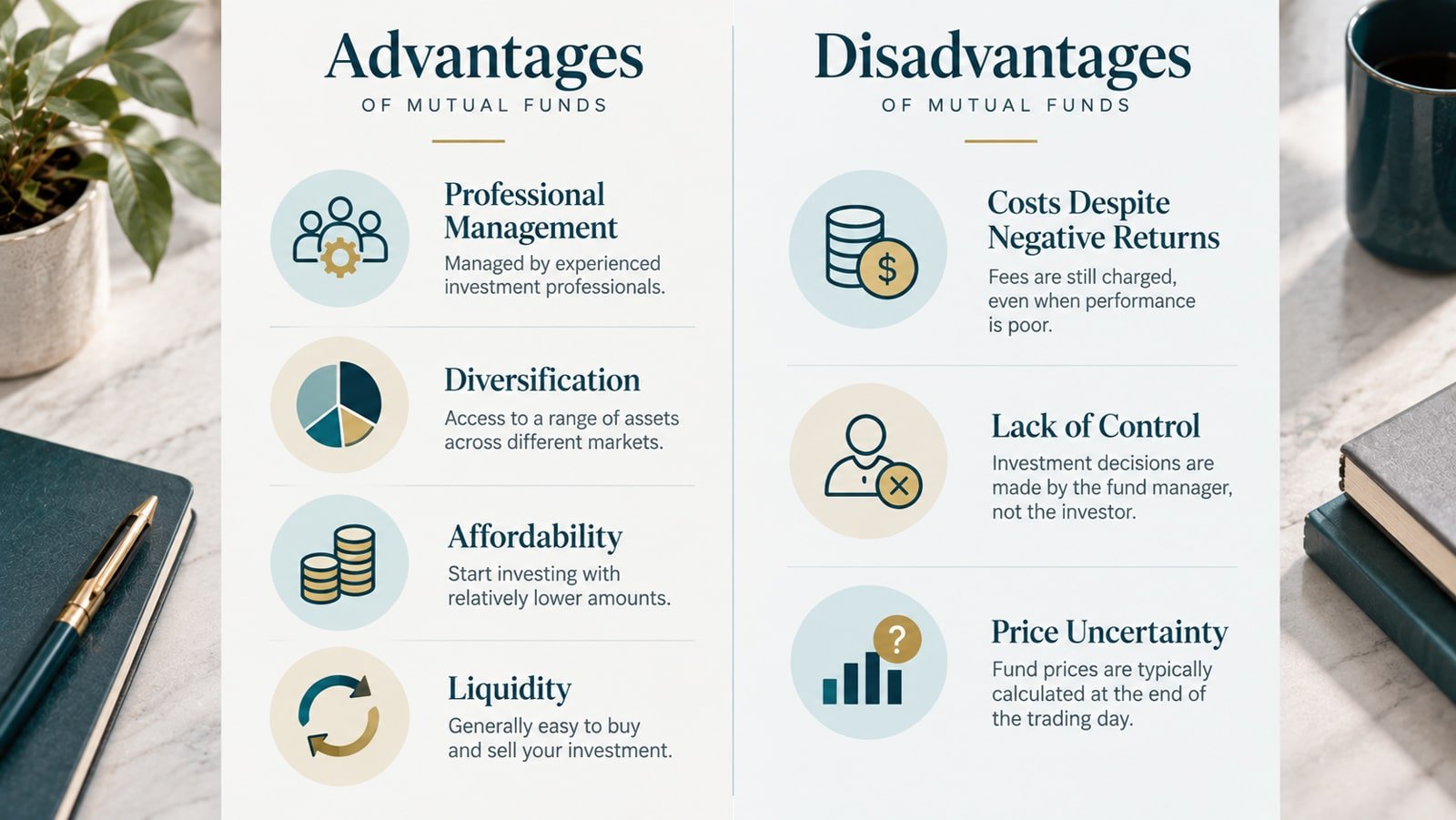
Advantages
Mutual funds can provide an attractive investment choice because they generally offer:
Professional ManagementProfessional money managers research, select, and monitor the performance of the securities the fund purchases. |
DiversificationSpreading investments across a wide range of companies and industry sectors, for example, can help lower your risk if a company or sector fails. Some investors find it easier to achieve diversification through ownership of mutual funds rather than through ownership of individual stocks or bonds. |
AffordabilitySome mutual funds accommodate investors who don’t have a lot of money to invest by setting relatively low dollar amounts for initial purchases, subsequent monthly purchases, or both. |
LiquidityMutual fund investors can readily redeem their shares at the current Net Asset Value (NAV) at any time minus any fees and charges assessed on redemption. |
Disadvantages
But mutual funds also have features that some investors might view as unfavourable, such as:
Costs Despite Negative ReturnsInvestors must pay sales charges, annual fees, and other expenses regardless of how the fund performs. |
Lack of ControlInvestors typically cannot ascertain the exact make-up of a fund’s portfolio at any given time, nor can they directly influence which securities the fund manager buys and sells or the timing of those trades. |
Price UncertaintyWith an individual stock or bond, you can obtain real-time (or close to real-time) pricing information with relative ease by checking financial websites or by calling your broker. You can also monitor how a stock’s or bond’s price changes from hour to hour. By contrast, with a mutual fund, the price at which you purchase or redeem shares will typically depend on the fund’s NAV, which the fund might not calculate until the end of the business day |
Choosing a Mutual Fund That Fits Your Financial Goals
Before you invest in any given fund, decide whether the investment strategy and risks of the fund are a good fit for you. The first step to successful investing is figuring out your financial goals and risk tolerance, either on your own or with the help of a financial professional. Once you know what you’re saving for, when you’ll need the money, and how much risk you can tolerate, you can more easily narrow your choices.
Ultimately, choosing a mutual fund is about finding an investment that aligns with your objectives, time horizon and comfort with risk. Taking the time to understand your options can help you make more informed investment decisions and build a portfolio suited to your financial goals.
Need help choosing the right investment approach? Contact Sterling Asset Management to discuss your financial goals and explore mutual fund options that may be suitable for you.
FAQs
What are the main types of mutual funds?
The three main types are money market funds, bond funds and equity funds. Each invests in different assets and carries different levels of risk and potential return.
Which type of mutual fund has the lowest risk?
Money market funds generally carry lower risk because they typically invest in high-quality, short-term investments. However, their returns may be lower and can be affected by inflation.
What is the difference between bond funds and equity funds?
Bond funds primarily invest in fixed-income securities issued by governments or companies, while equity funds invest in stocks. Equity funds generally experience greater short-term price fluctuations.
What are the main advantages of investing in mutual funds?
Mutual funds can offer professional management, diversification, affordability and liquidity. They allow investors to access a portfolio of investments without selecting and managing every security themselves.
How do I choose the right type of mutual fund?
Consider your financial goals, investment time horizon and tolerance for risk. The fund’s investment strategy, potential returns, fees and risks should align with what you want to achieve.