
Key Takeaways:
- Global bonds can provide Jamaican investors with USD income and diversification.
- Higher bond yields in 2026 create stronger opportunities for fixed-income investors.
- Bonds generate returns through regular coupon payments and potential capital gains.
- Bond risks can be reduced through diversification, quality selection and suitable maturities.
- Jamaican investors can access global USD bonds through a licensed asset manager.
- A tailored global bond strategy can balance steady income, risk and long-term goals.
How Jamaican Investors Can Access USD & Global Bonds to Build Steady Income
If you need help with a global bond investment strategy, you are not alone. For Jamaican investors, USD-denominated bonds represent one of the most reliable ways to earn steady income, help protect wealth from currency depreciation and gain exposure to international markets with typically lower volatility than equities.
This guide answers the three questions investors ask most: what a global bond strategy actually is, how bonds generate income, and whether investment bonds are risky. It also explains exactly how to access global USD bonds as a Jamaican investor.
Global bonds are fixed-income securities issued by governments or corporations outside your home market. For Jamaicans, the most relevant category is USD-denominated bonds, which pay interest and principal in US dollars, providing both income and a natural currency hedge.
What Is a Global Bond Investment Strategy?
A global bond investment strategy is a deliberate approach to allocating a portion of your portfolio to fixed-income securities issued by governments, corporations, or supranational bodies in international markets. The goal is to generate predictable income while diversifying beyond any single country’s economic cycle.
For Jamaican investors, a global bond strategy typically means holding USD-denominated bonds issued by sovereign governments (such as the United States or Caribbean nations) or investment-grade corporations. This differs from holding JMD-denominated bonds, where investors remain exposed to Jamaican dollar depreciation and domestic inflation.
In practice, the right investment strategy depends on your income needs, time horizon, and how much volatility you can tolerate.
Explore Global US $ Bond Options.
How Is a Global Bond Strategy Structured?
A global bond strategy is typically built around an investor’s objectives, risk tolerance and investment horizon. Rather than simply selecting individual bonds, the strategy considers how different fixed-income investments work together to balance income, risk and potential returns.
Key considerations may include:
- Income requirements versus capital growth: Determining whether the priority is generating regular income, preserving capital or pursuing longer-term growth.
- Bond maturity and duration: Balancing shorter and longer-term bonds based on interest rate sensitivity and investment objectives.
- Sovereign versus corporate exposure: Deciding how much of the portfolio should be allocated to government and corporate bonds.
- Issuer and credit quality: Assessing the financial strength and creditworthiness of individual bond issuers.
- Diversification across issuers and markets: Spreading exposure to help manage concentration risk across companies, sectors and countries.
- Liquidity requirements: Considering how easily investments may need to be converted into cash.
Why a Global Bond Strategy Makes Sense in 2026
The case for global bonds is especially strong right now. Ten-year government bond yields are trading near levels not seen since 2011, according to J.P. Morgan’s Global Bond Monitor Q2 2026. That means investors entering the market today are locking in higher income than was available for most of the past decade.
Three conditions are aligning in favor of fixed income:
| 1. Falling central bank rates: Cash returns are declining as the U.S. Federal Reserve continues its rate-cutting cycle, making bonds relatively more attractive. |
| 2. Higher starting yields: The reset in global bond yields has restored fixed income’s ability to generate meaningful income, with government bond yields remaining substantially higher than during the ultra-low-rate period. |
| 3. Equity market uncertainty: Bonds provide a counterweight when equity markets experience turbulence, restoring the classic balanced-portfolio dynamic. |
Bottom line: A global bond strategy is not a conservative fallback. It is a deliberate income and diversification play that works particularly well for investors who want USD exposure without the day-to-day volatility of stocks.

How Do Bonds Generate Income from Investment Bonds?
Investment bonds generate income through two primary mechanisms: coupon payments and capital appreciation.
Coupon Payments
When you buy a bond, you are lending money to the issuer (a government or corporation) for a fixed period. In return, the issuer pays you a coupon, a regular interest payment, typically every six months. The coupon rate is set at issuance and expressed as a percentage of the bond’s face value.
| Example: A USD bond with a face value of $10,000 and a 5% annual coupon pays you $500 per year, or $250 every six months, regardless of what happens in the stock market. |
Capital Appreciation
Bonds can also increase in value before they mature. If interest rates fall after you purchase a bond, the price of your existing bond rises because its fixed coupon becomes more attractive relative to newly issued bonds. Selling at that higher price produces a capital gain on top of the income you have already received.
For a deeper look at how returns work across different bond types, see Sterling’s guide on bonds: understanding yields and returns.
Are Bonds Risky? What Jamaican Investors Need to Know
Bonds carry risk, but the risks are specific and manageable. Understanding them is the difference between a well-structured investment strategy and an unpleasant surprise.
The Main Risks to Know
| Interest rate risk: Bond prices move inversely to interest rates. If rates rise after you buy, your bond’s market value falls. This only matters if you sell before maturity; hold to maturity and you receive the full face value. |
| Credit risk: The issuer may default and fail to make coupon payments or repay principal. Investment-grade bonds (rated BBB or higher) carry significantly lower default risk than high-yield bonds. Sovereign bonds from stable governments sit at the lowest-risk end of the spectrum. |
| Currency risk: For Jamaican investors holding USD bonds, this risk actually works in your favor over the long term. The JMD has historically depreciated against the USD, meaning USD bond returns tend to grow in Jamaican dollar terms over time. |
| Liquidity risk: Some bonds trade less frequently than others, meaning you may not be able to sell quickly at a fair price. Working with an experienced asset manager mitigates this significantly. |
The honest answer to “are bonds risky?” Yes, but far less so than equities for most investors. The key is matching bond type and maturity to your investment horizon. Holding a bond to maturity removes the need to realise interim price losses, provided the issuer repays the bond as agreed.
Explore the blog on How Risky Are Bonds?
Need Help with Global Bond Investment Strategy? Here’s How to Access USD Bonds
Accessing global USD bonds from Jamaica is straightforward when you work with a licensed asset manager. Here is how the process works in practice.
Step 1: Establish Your Investment Profile
Before selecting any bond, a good advisor will assess your risk tolerance, investment horizon, and income goals. This determines whether you are better suited to short-duration government bonds, longer-duration corporate bonds, or a blended approach.
Step 2: Choose Your Bond Type
| Bond Type | Issuer | Risk Level | Typical Use |
| Sovereign bonds | Governments (U.S., Caribbean) | Low | Capital preservation, steady income |
| Investment-grade corporate | Large corporations | Low to medium | Higher yield with manageable risk |
| High-yield corporate | Smaller or lower-rated companies | Medium to high | Growth-oriented portfolios |
Step 3: Access the Market Through a Licensed Manager
Individual investors in Jamaica typically access global bonds through a licensed securities dealer or asset manager rather than purchasing directly on international exchanges. This provides:
- Professional bond selection and due diligence
- Access to institutional pricing and a broader inventory
- Ongoing portfolio monitoring and reinvestment guidance
Sterling Asset Management’s Global USD Bond service gives Jamaican investors direct access to a curated selection of USD-denominated investment bonds, with guidance from advisors who specialize in this asset class.
You can also explore how USD fixed income fits into a longer-term plan through Sterling’s USD fixed income in retirement planning resource.
The minimum entry point varies by bond and structure. Sterling’s current minimum investment starts from approximately US$5,000, although this may vary depending on the bond selected. Speaking with an advisor is the fastest way to understand what is available at your investment level.
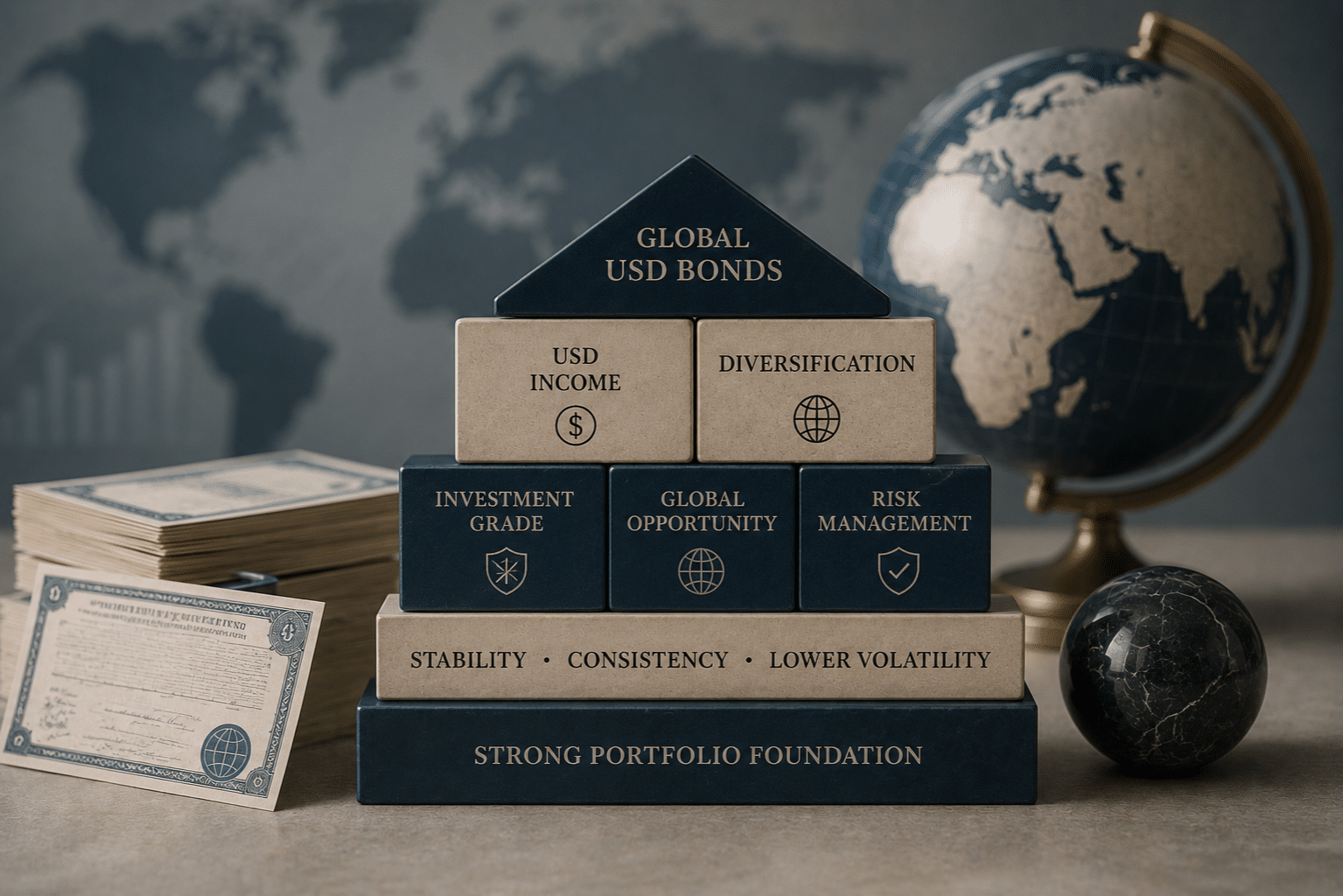
Build Your Global Bond Investment Strategy With Sterling
Global bonds are not a niche product for institutional investors. They are a practical, accessible tool for any Jamaican investor who wants USD income, portfolio diversification, and a lower-volatility alternative to equities.
The 2026 environment is particularly favorable: yields are at multi-year highs, central banks are cutting rates, and over $8 trillion in global cash is moving into fixed income as investors seek better returns than cash accounts can offer.
Sterling Asset Management has specialized in global USD bond investing for over 25 years. Our advisors help clients identify the right bonds for their goals, manage risk across their portfolio, and reinvest income strategically over time.
Ready to build your investment bond strategy? Explore our Global USD Bond service or speak with a Sterling advisor to get started.
FAQs
What is the difference between a global bond and a local bond?
A local bond is issued in Jamaican dollars by the Jamaican government or a local company. A global bond is issued in a foreign currency (most commonly USD) by an international government or corporation. Global bonds expose you to international markets and provide USD income.
How do bonds generate income for investors?
Bonds generate income primarily through coupon payments: fixed interest payments made to the bondholder on a regular schedule, typically every six months. At maturity, the investor also receives the bond’s full face value. If the bond is sold before maturity at a higher price than it was purchased, the investor earns a capital gain as well.
Are investment bonds a safe investment?
Investment-grade bonds are among the lower-risk asset classes available to investors. The primary risks are interest rate movements and issuer default, both of which can be managed through careful bond selection, diversification across issuers, and matching bond maturity to your investment timeline.
Can Jamaican investors buy U.S. government bonds?
Yes. Jamaican investors can access U.S. Treasury bonds and other USD-denominated sovereign and corporate bonds through a licensed Jamaican asset manager. Direct purchase on U.S. exchanges is also possible but involves additional complexity and regulatory requirements.
What is a good global bond investment strategy for beginners?
A beginner global bond strategy should prioritise diversification, credit quality and a maturity profile aligned with the investor’s income needs and investment horizon. Investment-grade sovereign and corporate bonds can form the core of the portfolio, while the exact mix and maturities should reflect the investor’s goals and risk tolerance.